
Birdeye often suits multi-location brands needing listings management and survey tools across various sites; Podium is often better for businesses using text messaging intensively and requiring integrated payments. Neither platform is inexpensive. Contract terms, per-location fees, and add-ons frequently cause actual costs to exceed the advertised price, so choosing a platform mismatched to your workflow can be costly in time and money.
TL;DR:
- Birdeye excels in managing listings across multiple locations and offers extensive survey tools, making it ideal for regional or franchise oversight.
- Podium provides a unified SMS-based communication and payment platform, best suited for high-volume text-centric businesses like auto and medical services.
- Both platforms' advanced features, including automation and AI, are usually restricted to higher-tier plans, increasing overall costs.
- Contract renewal issues are common, with automatic renewals and difficult mid-contract changes often surprising users and adding to expenses.
- Neither platform fully meets compliance standards beyond basic security, so specific industry certifications like PCI DSS or SOC 2 should be requested upfront.
Table of Contents
- Birdeye vs Podium: Quick Comparison
- How Do Birdeye and Podium Handle Messaging and Listings Differently?
- What Contract and Cancellation Complaints Come Up Most?
- Which Platform Has a Better Mobile App?
- Do Birdeye and Podium Meet Compliance Standards Beyond HIPAA?
- Are There Real Case Studies Showing Performance Differences?
- How Customizable Is Each Platform's Automation?
- Should You Buy a Platform or Hire a Managed Team?
- A Third Option: Skip the Platform Entirely
- Sources
Birdeye vs Podium: Quick Comparison
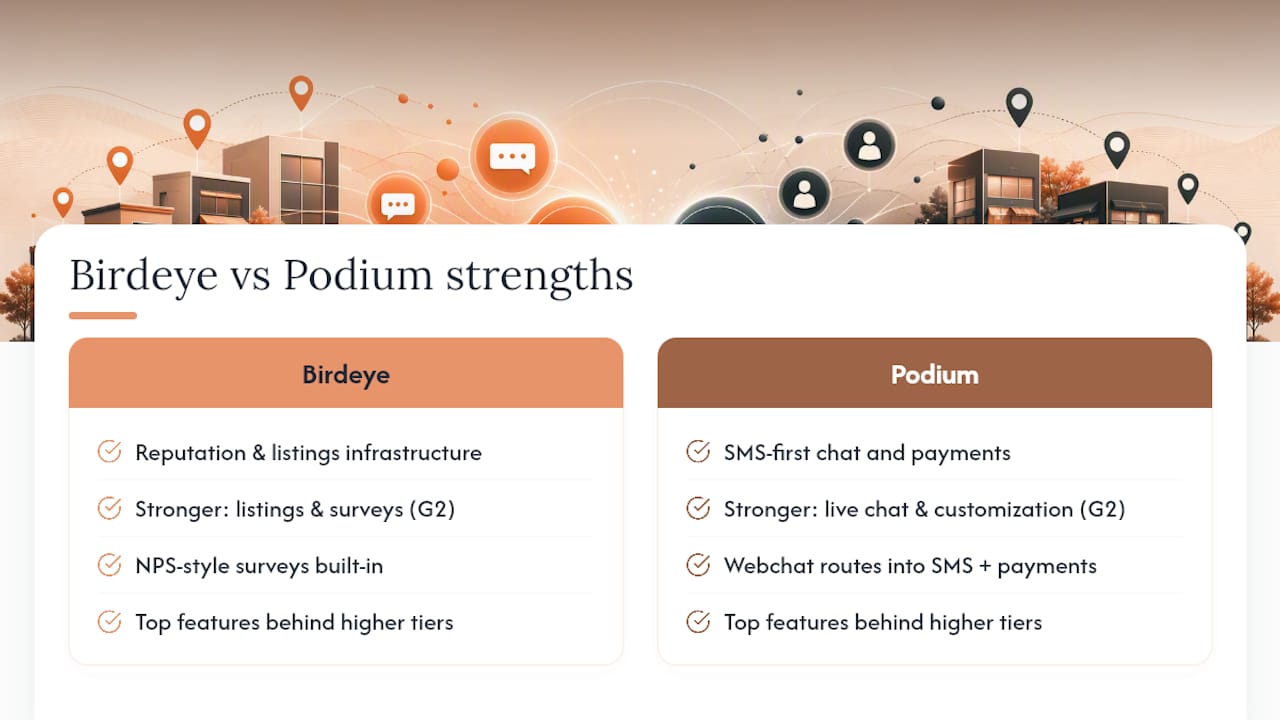
Before you sit through two sales demos, narrow the field. Birdeye's center of gravity is reputation and listings infrastructure; Podium's is SMS-first conversation and payments. Everything else, including Reputation, Chatmeter, and Pluspoint, orbits that same split between reputation monitoring at scale and text-based customer interaction.
Three things stand out once you look past the marketing pages. First, Birdeye's edge is breadth: it syncs listings across a wide directory network and layers in NPS-style surveys most competitors treat as an afterthought. Second, Podium's edge is depth in one channel: its webchat routes straight into SMS, and payments ride along in the same thread, so a customer can go from "are you open Saturday" to a paid invoice without leaving text. Third, both vendors gate their better features behind higher tiers, so the plan that looks affordable on a landing page rarely matches what a multi-location buyer actually pays.
G2's side-by-side data backs the split: Birdeye scores stronger on listings and survey categories, while Podium scores stronger on live chat and customization. That's not a tiebreaker, it's the actual decision criterion.
How Do Birdeye and Podium Handle Messaging and Listings Differently?
The honest answer is that they're built around different customer journeys, and that shapes daily staffing more than any feature checklist does.
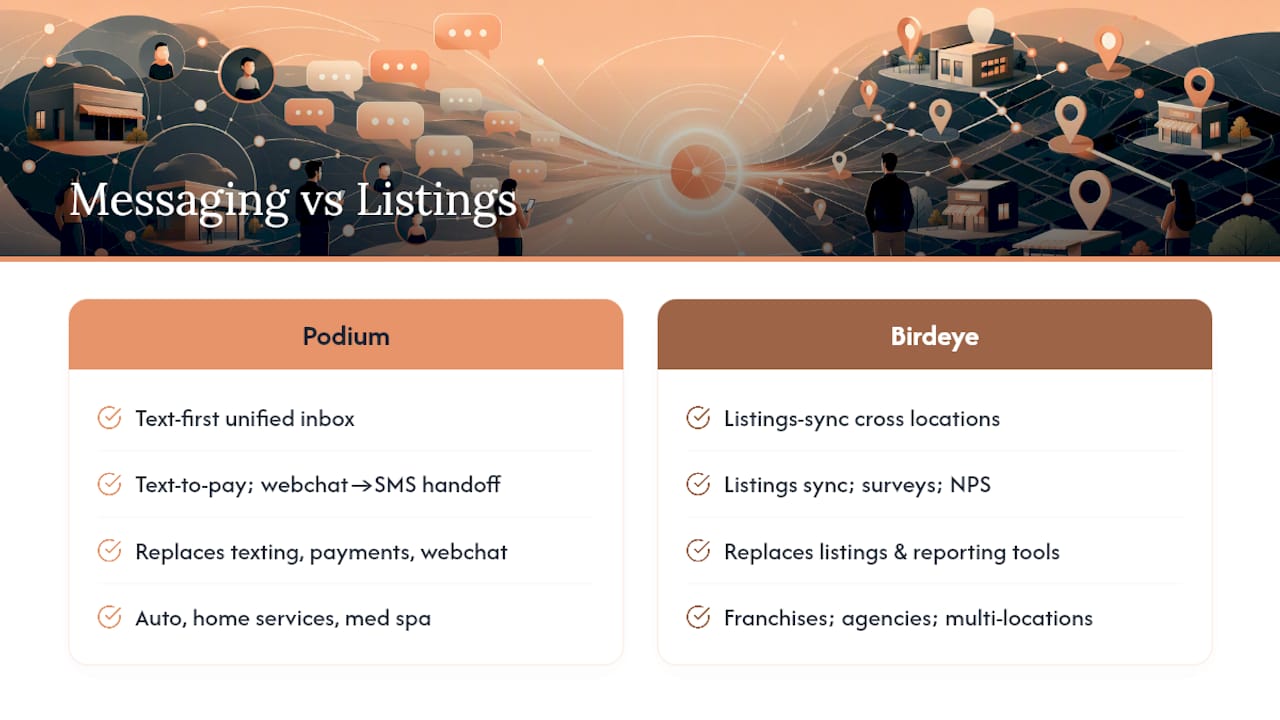
Podium assumes your front desk lives in a phone. A customer texts a question, a staff member answers from a unified inbox, and if the conversation turns into a sale, the payment link goes out in the same thread. Reviewers consistently point to text-to-pay and the webchat-to-SMS handoff as the reasons they justify Podium's price, especially in auto, home services, and med spa businesses where phone tag kills conversions. Businesses running heavy volumes on text often use Podium to replace three separate tools: a texting platform, a payment processor, and a webchat widget. That consolidation is the real value case, not the review requests.
Birdeye assumes your problem is visibility across dozens of locations, not a single conversation thread. Its listings sync keeps business hours and addresses accurate across a broad directory network, and its survey and NPS tooling lets a regional manager see which of forty locations is bleeding customer satisfaction before the reviews show it. Multiple comparison write-ups point to Birdeye as the pick when the buyer needs listings sync, survey programs, and agency-grade white-label reporting for a client roster or a franchise network.
AI and automation features exist on both platforms, but expect them gated behind mid or top tiers, things like AI-drafted review responses or predictive sentiment flags rarely ship on the entry plan. Support quality tracks the same pattern: Birdeye leans on a dedicated customer success manager model suited to enterprise onboarding timelines, while Podium's onboarding tends to move faster since the core workflow (texting) needs less configuration than a listings sync across dozens of directories.
Pro Tip: Ask both vendors for a live walkthrough using your actual location count, not a demo account with three sample locations. AI response drafting and advanced automation often look identical in a demo and behave very differently once you're paying for the tier that unlocks them.
What Contract and Cancellation Complaints Come Up Most?
Auto-renewal is the recurring complaint across both platforms. Reviewers on Capterra, G2, and Trustpilot repeatedly describe contracts that renewed automatically without a clear reminder window, plus cancellation fees that surprised them mid-term. This isn't unique to Birdeye or Podium, it's endemic to annual SaaS contracts in this category, but it shows up often enough in both vendors' review threads that it deserves a specific question in your demo call: what is the renewal notice period, and what happens if you cancel three months into a twelve-month term?
Multi-location buyers report a second friction point: adding or removing a location mid-contract often triggers a renegotiation rather than a simple line-item change. If you're planning to open two new locations this year or close an underperforming one, get that process in writing before signing anything. Sales reps will tell you it's flexible; the contract language is what actually governs.
The FTC's 2024 rule against fake reviews and testimonials adds a separate layer of risk worth raising directly with either vendor: ask how their review request automation stays compliant with disclosure requirements, since automated incentivized review campaigns are exactly what the rule targets.
Which Platform Has a Better Mobile App?
Podium's app mirrors its desktop priority: the inbox is front and center, and staff can answer a text, send a payment link, or pull up a webchat handoff from a phone without much friction. For a service business where the "office" is a truck or a treatment room, that matters more than dashboard depth.
Birdeye's app leans toward monitoring rather than conversation. Regional managers use it to check review alerts, glance at survey scores across locations, and approve responses on the go, but the deeper listings management and reporting still work better on a full browser. That's a reasonable tradeoff for its buyer profile: nobody's syncing forty directory listings from a phone screen anyway.
Neither app fully replaces the desktop experience, and interface complaints on both platforms tend to center on notification overload once you're managing more than a handful of locations. If your team lives on mobile all day, test the app during your trial period, not just the sales demo, since app performance under real message volume is where both platforms show their limits.
Do Birdeye and Podium Meet Compliance Standards Beyond HIPAA?
Healthcare-adjacent buyers ask about HIPAA first, but industries like auto and financial services care about different certifications. Both vendors publish general security practices (encryption in transit, SOC 2 alignment claims appear in vendor materials), though neither publishes a full, independently audited compliance matrix on their public pricing pages.
If your business handles payment data through Podium's text-to-pay feature, ask specifically about PCI DSS compliance for that payment flow, since text-to-pay tools introduce a payment processing layer that a pure messaging tool doesn't carry. If you're in financial services or legal, ask both vendors directly for their current SOC 2 report rather than relying on marketing copy, and get it in writing before you sign, not after.
Are There Real Case Studies Showing Performance Differences?
Vendor-published case studies tend to favor whichever metric each platform is built to move, so read them with that lens. Birdeye's published examples typically highlight review volume growth across a franchise network or improved listing accuracy after a directory sync cleanup. Podium's tend to highlight faster response times and revenue tied directly to text-based payment links, numbers that are easier to attribute because the payment happens inside the platform.
Neither vendor publishes a rigorous head-to-head performance study, and independent, controlled comparisons of outcome data between the two are hard to find. Treat vendor case studies as directional evidence of what each platform optimizes for, not proof of which one will outperform for your specific business. The NiceJob comparison is a useful reference point if you're also considering Podium against smaller review-focused competitors, since it isolates the review-generation angle specifically.
How Customizable Is Each Platform's Automation?
Podium's automation centers on conversation triggers: a missed call auto-texts the customer, a completed job auto-sends a review request, a webchat conversation can auto-route to the right team inbox. Customization here means building rules around messages, and G2's category data backs Podium as the stronger performer specifically on customization among the two.
Birdeye's automation centers on workflows across locations: survey trigger rules after a service visit, automated response templates that route by sentiment score, and listings updates that push to dozens of directories from one change. That's a different kind of customization, more about scale and consistency across many locations than about conversational nuance in a single thread.
Both platforms gate deeper automation rules behind higher-priced tiers, so the "automation" a sales rep demos on a starter plan often isn't what you'll actually get without upgrading.
Should You Buy a Platform or Hire a Managed Team?
A platform makes sense when you have staff who can own it daily: someone answering texts, someone auditing listings, someone reading survey data and acting on it. When that staff time doesn't exist, the platform becomes expensive software nobody logs into. Chrome Cactus Studio works with a small roster of clients precisely because senior-led, hands-on work produces faster map pack and organic visibility gains than a self-managed tool sitting unused. Clients have seen rapid ascension to statewide #1 rankings shortly after launch. If you're weighing platform cost against outcomes, measure results in weeks of visible ranking movement, not months of dashboard configuration.
— Anas
A Third Option: Skip the Platform Entirely
Birdeye and Podium both solve real problems, but they're tools you have to run, and running them well takes staff time most small and mid-sized businesses don't have sitting idle. Chrome Cactus Studio is the alternative for owners who want the outcome, better map pack rankings, stronger organic visibility, more inbound calls, without becoming the person who logs in daily to manage surveys or chase listing sync errors.

Chrome Cactus Studio is a boutique SEO agency in Scottsdale that works with a limited roster of clients so senior practitioners handle every part of the engagement directly, no juniors, no handoffs. That includes local search and map pack optimization, AI search visibility so your business gets cited in tools like ChatGPT and Perplexity, and authority-building content, the kind of work a reputation platform doesn't touch at all. If your team is small and your time is better spent running the business than running software, see how Chrome Cactus Studio's method works and get a quote for your market.
Sources
- Federal Trade Commission announces final rule banning fake reviews, testimonials
- Compare Birdeye vs Podium | G2