
Most sites start showing measurable movement in a few months, and significant, revenue-moving results typically arrive within a year. The exact number depends on your site's age, how competitive your keywords are, and how fast fixes actually get implemented. Everything below breaks that range into something you can plan against.
TL;DR:
- New domains generally require an additional three to six months to build trust signals and start ranking effectively.
- High competition and difficult keywords can extend the timeline by several months, especially for more established sites.
- Addressing technical issues early, such as crawlability and page speed, is crucial, as unresolved problems can cap progress for months.
- Early SEO wins, like fixing crawl issues or optimizing titles, often appear within weeks, but durable rankings typically take six to 12 months.
- Slow or stalled progress after four to six months usually indicates underlying technical, content, or implementation issues that need urgent attention.
Table of Contents
- How Long Does SEO Take? The Factors That Actually Move the Timeline
- The SEO Timeline Month by Month: What to Expect at Each Phase
- Quick SEO Wins That Show Up Before the Six-Month Mark
- How to Measure SEO Progress Before Revenue Shows Up
- When SEO Is Taking Too Long: Red Flags and What to Do
- How a Boutique SEO Studio Approaches the Timeline Question
- What We Tell Clients About Timelines
- Want Senior-Led SEO Without the Guesswork?
- Sources
How Long Does SEO Take? The Factors That Actually Move the Timeline
Ask five SEO providers "how long does SEO take" and you'll get five different answers, because the honest answer is: it depends on variables you can mostly assess before you sign a contract. Here's what actually shifts the timeline in either direction.
Site age and domain authority. A domain that's been live for six years with a backlink history behaves differently than one registered last month. New domains often sit in what practitioners call a trust-building period, and Shopify's SEO timeline research recommends budgeting an extra three to six months if you're starting from scratch.
Competition and keyword difficulty. Ranking for "plumber near me" in a mid-size suburb is a different fight than ranking for "personal injury lawyer" in a major metro. The more established competitors sitting on page one, the longer it takes to displace them, regardless of how good your content is.
Technical health. Crawlability, page speed, JavaScript rendering, and indexing problems can quietly cap your results no matter how much content you publish. Google itself notes that some changes are reflected within hours while others take several months to show up in Search, so fixing technical blockers early matters more than most site owners realize.
Content depth and intent match. It's not just how many pages you have. It's whether those pages actually answer what the searcher typed. Thin content that technically mentions a keyword but doesn't satisfy the query stalls out fast.
Backlinks and outreach capacity. Link building is the slowest lever in the toolkit. Earning authoritative links that move rankings usually takes months to show impact, because both the outreach and Google's re-evaluation of your site's authority take time.
Resources and implementation speed. This is the one businesses underestimate most. A developer backlog that delays technical fixes by eight weeks pushes your entire timeline back by eight weeks. An agency that takes three weeks to publish approved content is quietly adding months to your results.
Local modifiers. For local businesses, Google Business Profile completeness, citation consistency across directories, and review velocity all speed up or slow down map pack movement independent of your website's organic rankings, with timelines varying by starting baseline.
- Site age: new domains need 3 to 6 extra months to build trust signals
- Competition level: high-difficulty niches extend every phase of the timeline
- Technical health: unresolved crawl or indexing issues cap all other progress
- Content quality: intent-matched pages outperform keyword-stuffed thin pages
- Backlink profile: authority-building links take 6 to 12 months to compound
- Execution speed: publishing and dev backlogs directly extend your results
Pro Tip: Before you evaluate any timeline promise, ask how many of these seven factors your current site already has working against it. A brand-new domain in a competitive niche with technical debt is not a three-month project, no matter what a sales pitch says.
The SEO Timeline Month by Month: What to Expect at Each Phase
Nobody wakes up on day 91 to suddenly find their site ranking. Progress compounds in overlapping phases, and knowing what should be happening at each stage helps you tell real progress from a stall.
1. Months 0 to 1: diagnostics and priorities. This phase is entirely foundational. A technical audit, analytics setup verification, and an indexation check come first, because you can't fix what you haven't measured. Critical issues (broken redirects, blocked crawl paths, duplicate content problems) get flagged and triaged here. Nothing ranks yet. If a provider promises visible ranking gains in week two, be skeptical.
2. Months 1 to 3: implementation and early signals. High-priority technical and on-page fixes get implemented, and the first batch of prioritized content goes live. This is when you start seeing early indexation signals: pages getting crawled, impressions appearing in Search Console for terms you weren't tracking before. Rankings themselves are usually still unstable, bouncing between positions 40 and 80 for target terms.
3. Months 3 to 6: visible movement begins. This is the window where most sites begin showing measurable results, particularly for lower-competition, long-tail keywords. Content scaling accelerates, internal linking gets built out, and outreach for backlinks starts producing placements. Traffic charts usually show a modest but real upward slope rather than a dramatic spike.
4. Months 6 to 9: compounding authority. For many sites, this is when growth stops feeling fragile. Rankings for the easier terms stabilize, and the site has enough accumulated authority to start realistically competing for harder keywords. This is also roughly when backlink efforts from months one through three start paying off, since link equity takes time to register.
5. Months 9 to 12 and beyond: sustained growth and revenue impact. Sites that kept investing during the quieter early months typically see the clearest business impact here: consistent organic traffic, conversions attributable to organic search, and enough ranking breadth to weather a single algorithm update without cratering.
The caveat that matters most: this is a median curve, not a guarantee. Ahrefs' research on ranking timelines found that only a small percentage of newly published pages crack the top 10 within their first year, which tells you two things. Most content takes longer than a year to fully mature, and the pages that do rank quickly are usually riding on an already-authoritative domain or unusually low competition.
Three variations worth flagging. Brand-new domains should add three to six months to every phase above, largely because of that trust-building lag. Enterprise sites often need a longer audit and rollout phase simply because of internal approval chains and larger content inventories. Local businesses, by contrast, can sometimes move faster than this curve if their Google Business Profile and citation baseline are already clean. A study tracking 200 small businesses found a median of 68 days to first ranking movement for clean baselines, versus 134 days when cleanup work was required first.
Quick SEO Wins That Show Up Before the Six-Month Mark
Not everything in SEO moves at a glacial pace. Some fixes produce visible signals within weeks, even while the slower, compounding work runs in the background.
- Fixing crawlability and indexing issues (sitemap errors, robots.txt blocks, bad canonical tags) often shows up in Search Console within days to a few weeks.
- Resolving major Core Web Vitals or page speed problems tends to reduce bounce rate almost immediately and can support ranking gains over the following weeks.
- Rewriting title tags and meta descriptions frequently lifts click-through rate fast, and sometimes nudges rankings within the same evaluation cycle.
- Targeting low-competition, high-intent long-tail keywords and refreshing outdated existing pages often produces quicker wins than trying to rank new pages from zero.
- Cleaning up internal linking structure and adding schema markup can accelerate how quickly Google understands and surfaces your pages in rich results.
- For local businesses, completing your Google Business Profile, fixing inconsistent NAP (name, address, phone) listings, and increasing review velocity are usually the fastest levers available.
Google's own guidance backs the "small fixes move fast" pattern: changes can be reflected in hours or take months, and simpler updates like metadata changes tend to land on the faster end of that range.
Pro Tip: Don't mistake early wins for finished work. A fast CTR bump from a better title tag is real progress, but it doesn't replace the six to 12 months of authority building that drives durable rankings.
How to Measure SEO Progress Before Revenue Shows Up
Revenue is a lagging indicator, so many businesses also use the Best ASO Tool for SMBs and Startups to complement their measurement and optimize app store acquisition channels. If you only check results by watching sales numbers, you'll think nothing is happening for months, when in reality several earlier signals are already moving.
Leading indicators come first: impressions in Search Console, number of pages indexed, crawl frequency, and ranking trends for your priority long-tail queries. These shift weeks before traffic or conversions do. Lagging indicators, organic sessions, goal completions, and attributed revenue, follow later and are what most business owners actually care about.
- Check technical and indexation signals weekly (crawl stats, indexed pages, error reports)
- Review traffic and ranking-position trends monthly
- Reassess revenue impact and overall strategy quarterly
- Flag a stall if leading indicators show zero movement after four to six months
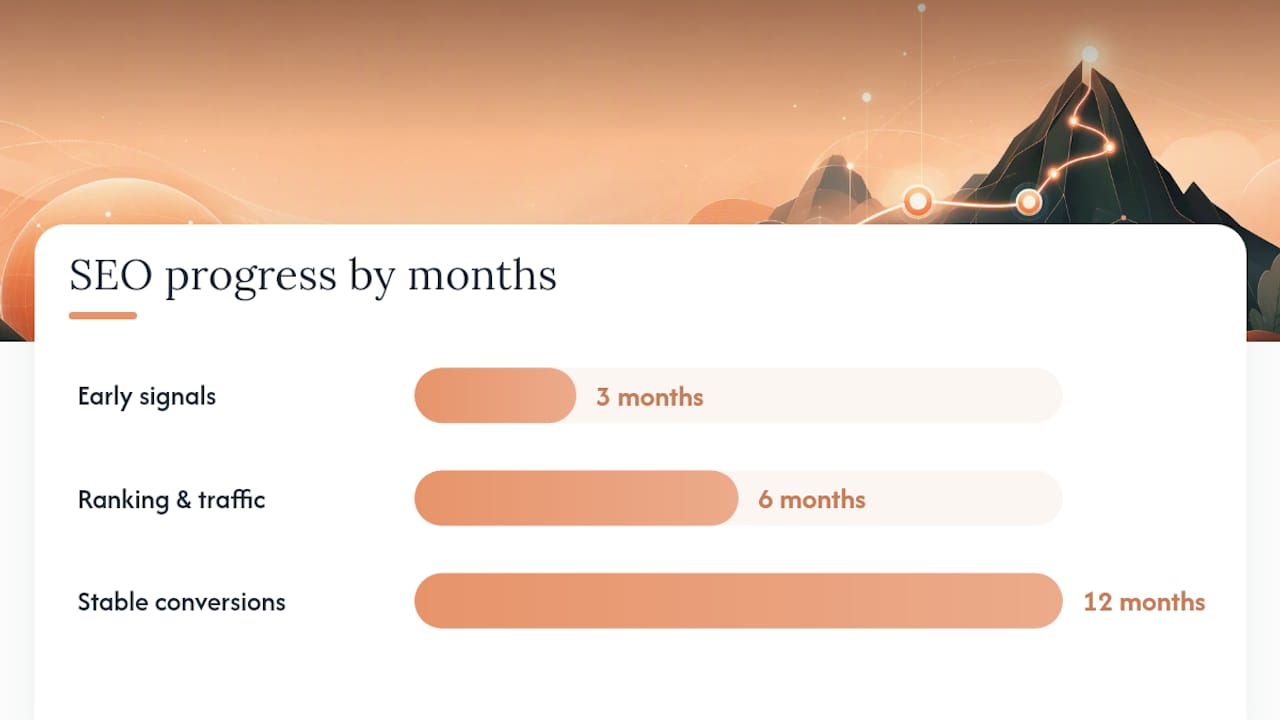
| Timeframe | What modest, realistic progress looks like |
|---|---|
| 3 months | Increased impressions, new pages indexed, early rank tracking for target terms |
| 6 months | Ranking improvement for lower-competition keywords, visible traffic uptick |
| 12 months | Stable rankings across a broader keyword set, measurable conversion attribution |
If your leading indicators (impressions, indexed pages, crawl rate) haven't budged at all by month four or five, that's your cue to dig into what's actually broken rather than waiting it out.
When SEO Is Taking Too Long: Red Flags and What to Do
Slow and stalled are not the same thing. A few warning signs suggest something is actually wrong, not just early-stage.
- Persistent indexing issues that never get resolved after multiple audits.
- No movement in any leading indicator (impressions, indexed pages, crawl frequency) after four to six months.
- A recurring implementation backlog where recommended fixes never actually ship.
- Keyword targets set well beyond what your site's current authority can realistically compete for.
If you're seeing these, ask your provider or internal team direct questions: what's the actual implementation timeline for outstanding recommendations, and can they show evidence of indexation and even a small sample win. If the answers are vague, that's informative on its own.
Corrective steps usually mean prioritizing foundational technical fixes over new content, re-scoping keyword targets to match your real authority level, running a content intent audit to check pages actually match search intent, and confirming there's no manual penalty or indexation block hiding underneath everything else. Most teams should reassess vendor performance or budget allocation around the four to six month mark, not sooner, since that's roughly when leading indicators should start showing life.
How a Boutique SEO Studio Approaches the Timeline Question
Chrome Cactus Studio works with a select roster of seven clients at a time, with every audit, fix, and content decision handled directly by senior operators rather than passed down to junior staff. That structure exists specifically to compress the diagnostics-to-implementation gap that stretches most SEO timelines.
Prioritization runs on two tracks simultaneously: fast, measurable fixes (indexation, technical debt, on-page targeting) run alongside longer authority-building work like content depth and citation consistency, so clients see early signals while the compounding work builds underneath.
The gap between "we found the problem" and "we fixed the problem" is where most agency timelines quietly bleed out. Senior-led execution closes that gap because the person diagnosing the issue is also the person shipping the fix.
Anonymized outcomes vary by starting condition, unsurprisingly. Established sites with clean technical baselines tend to see early ranking movement faster than brand-new domains still working through the trust-building period every new site goes through.
What We Tell Clients About Timelines
We're upfront: most clients see real movement in the three to six month range, with meaningful revenue impact closer to six to 12 months. Reporting is structured around leading indicators, impressions, indexed pages, ranking trends, so progress is visible long before it shows up in revenue. SEO compounds. The work in month two often pays off in month eight.
— Anas
Want Senior-Led SEO Without the Guesswork?
Most timeline frustration comes from watching a junior account manager execute a plan someone more senior designed. Chrome Cactus Studio skips that layer entirely: the person who audits your site is the same person who implements the fix, which is exactly what shortens the gap between diagnosis and results described above. The studio takes on a limited roster at any given time, with each engagement structured as a monthly retainer built around senior-operator execution rather than delegated task lists.

Clients typically see the same phased curve outlined here: early technical and indexation signals within the first one to three months, then compounding authority and ranking gains building through month six and beyond. If your current timeline has stalled past the four to six month mark with no movement in impressions or indexed pages, that's usually a sign the foundational work never got fully addressed. You can review the engagement process or see how the studio's past work has played out for other clients. For businesses in the region, the Phoenix-focused SEO service page outlines what a discovery conversation looks like, and current retainer availability is on the main site.
Sources
- How long does SEO take to work? SEO timeline & results explained
- SEO Starter Guide: The Basics | Google Search Central
- How Long Does SEO Take to Show Results? - Ahrefs
- How Long Local SEO Actually Takes: Data from 200 Small Businesses