
Winning local search comes down to four moves in order: a fully built-out Google Business Profile, a steady flow of new reviews, a handful of tightly written service pages, and clean, matching business listings everywhere your practice appears online. Get those right and most practices see movement in rankings within 2 to 3 months, with the investment paying for itself in new patient revenue somewhere around the 6 to 9 month mark. Start today by claiming your Google Business Profile and running a quick check of your name, address, and phone number across your top listings.
TL;DR:
- Google Business Profile accounts for about one-third of local ranking weight, making it essential to claim, verify, and optimize with accurate, detailed service entries.
- Generating and responding to recent reviews monthly, with a focus on authentic and personalized interactions, significantly impacts local search visibility and reputation.
- Building a handful of high-quality, keyword-specific service pages, each tailored to common patient questions and including clear calls to action, improves conversion rates and ranking.
- Earning local backlinks through sponsorships and community involvement helps establish prominence, but avoid low-value directory submissions to prevent spam flags.
- Technical SEO improvements, like schema markup and mobile optimization, combined with tracking booked appointments, are crucial for translating clicks into new patients and revenue.
Table of Contents
- Google Business Profile: Dentist-Specific Optimization Checklist
- Review Generation and Review Management for Dental Clinics
- Service Pages and Keyword Strategy: Build Pages That Convert Local Searchers
- Local Backlinks and Community Signals Dentists Can Realistically Earn
- Technical SEO and Conversion Fixes That Raise Rankings and Bookings
- Measurement and KPIs: Tie SEO Work to Phone Calls, Booked Appointments, and Revenue
- Costs and Timeline: Realistic Budgets and Expected Breakeven
- When to Hire a Senior-Led Boutique: What They Do and Expected Outcomes
- Optimizing for Local Voice Search and Mobile Search Behavior
- Leveraging Local Social Media Engagement to Boost SEO
- Using Geo-Tagged Images and Videos to Enhance Local Relevance
- Creating and Optimizing Google Posts for Dentists
- Incorporating Patient FAQs and Answer-Rich Content for Local SEO
- Implementing Local PPC Campaigns and Integrating With SEO Efforts
- What Actually Moves the Needle: An Editorial Take
- How Chrome Cactus Studio Helps Dental Practices Compete Locally
- Primary Sources and Tools
- Sources
Google Business Profile: Dentist-Specific Optimization Checklist
Google Business Profile signals make up roughly 32% of Local Pack ranking weight, more than any other single factor. That makes it the first thing to fix, not an afterthought once your website looks nice.
Start by claiming and verifying your listing through Google Business Profile if you haven't already. Pick "Dentist" as your primary category, then add secondary categories that match your actual services, such as "Cosmetic Dentist," "Pediatric Dentist," or "Emergency Dental Service" if those apply.
From there, work through this list:
- Build out the services menu with each procedure listed separately (implants, Invisalign, root canals) rather than lumped under "General Dentistry."
- Write a one or two sentence description for each service using patient-friendly language, not clinical jargon.
- Add your online booking link directly to the profile so patients can schedule without leaving Google.
- Upload photos weekly: exam rooms, your team, before-and-after cases (with consent), and the building exterior for easy navigation.
- Post Google Posts at least twice a month, covering promotions, new services, or office updates.
Check what patients actually see by searching your practice name in an incognito browser window. Common pitfalls include outdated hours, a missing booking link, and a services menu that hasn't been touched since the listing was created.
Pro Tip: Set a recurring 15-minute calendar reminder every other Friday just for GBP photo uploads and posts. Profiles that go stale for months lose momentum fast.
Review Generation and Review Management for Dental Clinics
Reviews account for about 24% of Local Pack ranking weight, and recency matters more than it used to. A practice with 200 reviews from three years ago now loses ground to a competitor with 40 reviews collected in the last six months.
Build this into your front-desk routine:
- Train staff to ask for a review verbally right after a positive appointment, before the patient leaves the chair.
- Send an automated text within two hours of checkout with a direct link to your Google review page (skip the extra click to a review-gating page).
- Follow up once, three days later, for anyone who hasn't responded.
- Respond to every review within 48 hours, thanking positive reviewers by first name only and never referencing treatment details.
- For negative reviews, acknowledge the concern generically, apologize for the experience, and move the conversation offline with a phone number. Never mention a diagnosis, procedure, or condition in a public reply.
Aim for a steady drip rather than a burst. Ten new reviews a month sustained over a year beats fifty in one week followed by silence.
Pro Tip: Keep response templates in a shared doc your front desk can use, but always personalize the first line so replies don't read like copy-paste.
Service Pages and Keyword Strategy: Build Pages That Convert Local Searchers
Generic "Our Services" pages rarely rank or convert. What works is a set of standalone pages built around your highest-value procedures, each targeting a specific keyword pattern: procedure plus modifier, like "dental implants cost" or "emergency dentist near me." One primary keyword per page, no exceptions.
Most single-location practices do well with 5 to 7 dedicated service pages covering implants, cosmetic dentistry, emergency care, sedation, pediatric care, general dentistry, and any specialty that drives revenue. Aim for 800 to 1,500 words per page, enough to answer real patient questions without padding.
Each page should include:
- A clear candidacy section explaining who the procedure is right for.
- A pricing range, even a broad one, since patients search "cost" constantly.
- A short FAQ block addressing the three or four questions patients ask most.
- A visible booking button above the fold and repeated at the bottom.
- Internal links to related procedures and to your reviews or testimonials page.
Practices that focus on a handful of high-value procedure pages instead of chasing every possible keyword tend to book more appointments with less content overall.
Local Backlinks and Community Signals Dentists Can Realistically Earn
Local sponsorships, press mentions, and referral pages carry real weight because they signal prominence in your actual community, not just on the internet in general.
Realistic sources worth pursuing:
- Sponsoring a youth sports team or school event in exchange for a link on the organization's site.
- Partnering with local hospitals or specialists for referral page mentions.
- Pitching a local news outlet a story angle (a free dental day, a scholarship, a community health initiative).
- Joining your Chamber of Commerce for a directory listing and networking access.
- Writing a short educational piece for a local parenting or lifestyle blog.
Track each link in a simple spreadsheet with the source, date, and anchor text used. Skip mass directory submission services entirely. They flood you with low-quality links that do little for rankings and occasionally trigger spam flags.
Pro Tip: A single link from your local Chamber of Commerce often does more for prominence than twenty links from generic business directories.
Technical SEO and Conversion Fixes That Raise Rankings and Bookings
Rankings only matter if the site converts once someone clicks through. Start with Core Web Vitals: compress images, lazy-load anything below the fold, and get your largest contentful paint under 2.5 seconds on mobile, since most dental searches now happen on a phone.
Schema markup gives Google structured signals about your practice. Six types matter most for dental sites, according to guidance from The Dental SEO Guide:
| Schema type | Where to add it |
|---|---|
| LocalBusiness/Dentist | Homepage and contact page |
| Service | Each individual service page |
| Person | Bio page for each clinician |
| AggregateRating | Testimonial or reviews page |
| FAQPage | Service pages and FAQ page |
| BreadcrumbList | Site-wide navigation |
Test your markup with the Google Rich Results Test before assuming it's live.
On conversion, three fixes move the needle fast:
- Make the phone number clickable and visible in the header on mobile.
- Add online booking widgets rather than a "contact us" form alone.
- Keep paid landing pages short and focused on one procedure, not a general homepage.
Sequence quick UX fixes first since they take days, then schedule developer work for speed and schema over the following month.
Measurement and KPIs: Tie SEO Work to Phone Calls, Booked Appointments, and Revenue
Most practices never connect their SEO work to actual booked appointments, which makes it impossible to know if the spend is paying off.
Track these on a monthly basis:
- GBP impressions and actions (calls, direction requests, website clicks) directly from the profile dashboard.
- Call tracking numbers on your website and GBP listing, tagged separately from your printed materials.
- A "how did you hear about us" field baked into your intake form or scheduling software.
- Organic new-patient count and the revenue attached to it, reviewed quarterly.
Once you have three months of data, you can calculate cost per new patient directly. Established local SEO programs commonly land in the $50 to $150 per new patient range, a benchmark worth checking your own numbers against.
Run small experiments, like changing a headline on one service page, and give each one 30 days before judging results.
Costs and Timeline: Realistic Budgets and Expected Breakeven
Expect early ranking movement in 2 to 3 months and breakeven, where new patient revenue exceeds spend, somewhere between 6 and 9 months for most single-location practices. Competitive metro markets sometimes push that timeline out further.
Budget ranges vary widely by approach. Doing it yourself costs mostly time plus small tool subscriptions, often under $200 a month. Fractional or part-time help typically runs a few hundred to around $1,500 monthly. Full-service, senior-led retainers for a single competitive location commonly land higher, reflecting direct strategist involvement rather than junior task execution.
A reasonable first-year allocation front-loads GBP and citation cleanup in months one and two, shifts budget toward service page content in months two through six, and sustains review generation and local link building throughout. Evaluate cost per new patient once you clear the 90-day mark, not before.
When to Hire a Senior-Led Boutique: What They Do and Expected Outcomes
Hire outside help when you lack the time, technical skill, or internal bandwidth to run GBP, citations, content, and measurement simultaneously and consistently. Trying to do all four half-heartedly often produces worse results than doing two of them well.
Senior-led engagements typically deliver:
- Clear prioritization instead of a scattershot task list.
- Hands-on GBP management and review system setup.
- Service pages written to convert, not just rank.
- Local backlink outreach and measurement tied to booked appointments.
Chrome Cactus documents pricing examples and engagement outcomes worth reviewing before you commit to any agency. Whoever you hire, put safeguards in the contract: your GBP and citation assets stay registered under the practice's name, you retain ownership of reviews and analytics access, and you get direct data access rather than a filtered monthly report.
Optimizing for Local Voice Search and Mobile Search Behavior
Voice search changes how people phrase dental queries. Instead of typing "dentist Scottsdale," someone talking to their phone says, "Find a dentist near me open now" or "Who takes emergency patients on Saturday." Those queries are longer, more conversational, and often carry urgency.
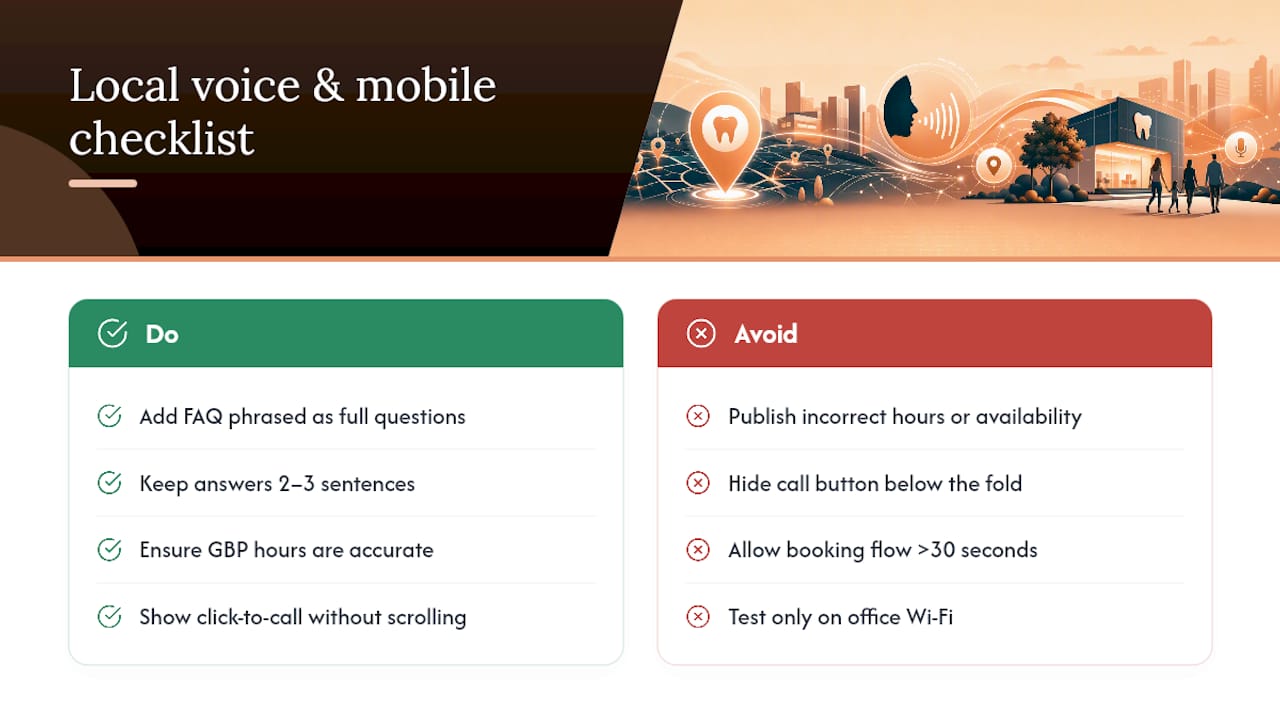
Structure content to match that pattern. Add an FAQ section to your homepage and top service pages phrased as full questions: "Do you accept walk-in emergencies?" or "Is teeth whitening covered by insurance?" Voice assistants pull answers from concise, direct text, so keep each answer to two or three sentences before expanding further if needed.
Hours, especially same-day or weekend availability, need to be accurate on your Google Business Profile since voice queries lean heavily on "open now" and "near me" phrasing. A mismatch between your posted hours and actual hours causes real damage here, both to rankings and to a patient who shows up to a locked door.
Mobile behavior compounds this. Most local dental searches happen on a phone, often while someone is dealing with pain or a broken tooth right now. That means your click-to-call button needs to be visible without scrolling, and your booking flow needs to work in under 30 seconds on a small screen. Test your own site on your own phone using cellular data, not office WiFi, since real patient conditions rarely match a fast office connection.
Leveraging Local Social Media Engagement to Boost SEO
Social signals don't directly move Google rankings the way GBP or citations do, but active local social profiles feed the same trust and prominence signals search engines pick up on indirectly through mentions, shares, and search behavior.
Focus energy on platforms where local engagement actually happens: Facebook and Instagram for most practices, with Nextdoor worth testing in suburban markets where neighborhood recommendations carry weight. Post practice updates, staff introductions, and community involvement rather than generic dental tips pulled from elsewhere. A photo from your booth at a local school health fair does more for local relevance than a stock graphic about flossing.

Encourage patients to tag your practice's location in their own posts when they mention their visit. That geo-tagged, organic content builds a footprint search engines and prospective patients both notice. Respond to comments and messages promptly since engagement rate on a business page factors into how often Facebook or Instagram surfaces your content to local users in the first place.
Cross-link your social profiles and your website consistently, and keep your business name and address identical to your GBP listing on every platform. A Facebook page still listing an old suite number undermines the same NAP consistency work you did elsewhere.
Using Geo-Tagged Images and Videos to Enhance Local Relevance
Photos and videos carry embedded metadata, including location data, that search engines can read even when the surrounding text doesn't mention a city name. Uploading images taken at your actual practice location, rather than generic stock photography, reinforces the geographic signals tied to your business.
Shoot photos on-site: your waiting room, your team, your equipment, exterior shots showing your signage and street. Name image files descriptively before uploading, using your city and procedure where relevant ("scottsdale-dental-implants-consultation.jpg" rather than "IMG_4821.jpg"). Add alt text that describes the image naturally, mentioning location only where it fits without forcing it.
Video works even harder for local relevance. A short walkthrough of your office, a team introduction, or a patient testimonial (with consent and no clinical details) filmed on-site gives Google and prospective patients tangible proof you operate a real, local practice. Upload these directly to your Google Business Profile and embed them on your service pages rather than only hosting them on YouTube.
Update your photo library regularly. A GBP profile with the same five photos from three years ago looks stagnant compared to a competitor uploading fresh images monthly, and Google's own guidance treats upload recency as one signal of an actively managed listing.
Creating and Optimizing Google Posts for Dentists
Google Posts appear directly in your Business Profile and occasionally in search results, giving you a free, recurring way to stay visible between major SEO wins. Treat them like a lightweight content calendar rather than an afterthought squeezed in once a quarter.
Rotate through a few post types: a seasonal promotion (teeth whitening before a big event season), a new service announcement, a staff spotlight, or a short educational tip tied to a common patient question. Each post should include a clear call to action button, whether that's "Book," "Call Now," or "Learn More," since Posts without a CTA button convert at a noticeably lower rate.
Keep the copy tight, under 300 characters ideally, with a strong first line since that's what shows in preview. Pair every post with an image, since text-only posts get skipped over far more often in a visual feed. Posts expire after seven days for most categories, so a twice-monthly rhythm keeps your profile looking active without demanding daily attention.
Incorporating Patient FAQs and Answer-Rich Content for Local SEO
FAQ content does double duty: it answers real patient hesitations that stall bookings, and it gives search engines clean, structured text to pull into featured snippets and AI-generated answers. Every service page should carry three to five FAQs specific to that procedure, not a generic list copied across every page.
Write answers the way you'd explain them to a nervous patient in the chair, plainly and without jargon. "Does a root canal hurt?" deserves a direct, reassuring, medically accurate answer in two or three sentences, not a paragraph of hedging. Mark these up with FAQPage schema so search engines can parse the question-and-answer structure directly.
Pull your actual FAQs from what your front desk hears every week. Ask your office manager for the five questions patients ask most before booking, and build content around those first rather than guessing. That real-world input consistently outperforms generic FAQ lists pulled from a competitor's site, because it's answering the specific hesitations your actual patients have.
Implementing Local PPC Campaigns and Integrating With SEO Efforts
Paid search fills the gap while organic rankings build. A new service page might take 2 to 3 months to gain traction organically, but a well-targeted Google Ads campaign can put that same page in front of local searchers within days.
Structure campaigns around the same procedure-plus-modifier keywords your service pages target: "emergency dentist [city]," "dental implants cost near me." Send traffic to the dedicated service page, not your homepage, since a focused landing page with a clear CTA converts paid clicks at a meaningfully higher rate than a general page asking visitors to figure out where to click next.
Use PPC data to sharpen your SEO strategy rather than running them as separate efforts. If a keyword converts well in paid search, that's a strong signal to invest more content depth into the matching organic page. If a keyword generates clicks but no bookings, that's worth knowing before you spend months trying to rank organically for it.
Set a modest, defined monthly budget and track cost per booked appointment separately from cost per click, since a cheap click that never converts to a patient isn't actually cheap. Pause underperforming ad groups monthly and reallocate toward whichever procedures are actually filling your schedule.
What Actually Moves the Needle: An Editorial Take
Most dental practices treat their website as the star of local SEO and Google Business Profile as an afterthought. That's backwards. A practice with a mediocre website and an obsessively maintained GBP profile beats a practice with a gorgeous site and a stale profile almost every time.
The one change worth making this week: audit your GBP services menu and rewrite it so every procedure you actually perform has its own listed entry with a real description. Most practices leave this half-finished, which quietly caps how much of the profile's ranking weight they ever capture. Pair that with the pricing and outcome data Chrome Cactus has published if you want a sense of what a properly resourced engagement actually looks like.
— Anas
How Chrome Cactus Studio Helps Dental Practices Compete Locally
Chrome Cactus Studio is the alternative to spreading your SEO across a junior account team: every practice we work with gets a senior operator handling GBP, reviews, content, and citations directly, with no handoffs and no delegation to entry-level staff.

We work with a limited roster on purpose. That means the strategist who audits your Google Business Profile is the same person writing your service pages and tracking your booked appointments three months later, not a rotating cast learning your practice from scratch every quarter. Deliverables typically include a full GBP and citation cleanup, a set of conversion-focused service pages, a review generation system, and monthly reporting tied to calls and bookings, not vanity traffic numbers.
If you're evaluating whether a boutique engagement fits your practice, ask any agency you're considering who actually does the work, how assets are owned, and how they measure success beyond rankings. Then book a consultation with Chrome Cactus Studio to see what a senior-led local SEO plan looks like for your specific market.
Primary Sources and Tools
Consult Google Business Profile directly for verification steps and feature updates. Use the Google Rich Results Test to confirm your schema markup validates correctly before publishing. Check the ADA Find-a-Dentist directory to confirm your listing is accurate and complete. Browse Chrome Cactus Studio's insights for pricing examples and real engagement outcomes.
Sources
Inconsistent business listings quietly undermine everything else you do. If your address reads "123 Main St." on one directory and "123 Main Street, Suite 200" on another, that mismatch signals unreliability to Google's algorithm.
Audit for exact matches: same suite number formatting, same phone number (not a tracking number on some sites), same business name spelling. Focus your energy on a short list of high-value directories rather than hundreds of low-quality ones:
- The Dental SEO Guide: How to Win Local Search for Your Practice in 2026 | Pete Johnson
- Local dental SEO: Put your practice on the map - Oral Health Group
- SEO for dentists: The Complete Guide (2026) | DentalBase
Run the audit manually for a single location, or use a citation management tool if you have multiple. Fixes typically take 4 to 8 weeks to fully propagate and show up in rankings, so patience matters here more than in most other tactics.