
To win local search, law firms must prioritize a fully optimized Google Business Profile, unique practice-area and location pages, and a systematic review and measurement workflow that favors signed consultations over vanity rankings. Get those four things right and everything else, from citations to schema, becomes reinforcement rather than heavy lifting. Skip them, and no amount of link building will save you.
TL;DR:
- Prioritize signed consultations over rankings as the main metric for local SEO success, since AI and paid ads now dominate map visibility.
- Use highly specific categories, accurate naming, and local content on Google profiles and location pages to improve relevance and ranking.
- Maintain consistent NAP data across key directories and use unique local phone numbers for each office to strengthen local relevance signals.
- Focus on gathering authentic reviews post-case completion using attorney-personalized requests, and respond promptly within 48 hours.
- Build practice-area and location-specific pages with jurisdictional detail, unique content, and proper internal linking to enhance search visibility and conversions.
Table of Contents
- Why Local SEO for Lawyers Looks Different Now
- Building a Google Business Profile That Actually Ranks
- What Makes a Practice-Area Location Page Rank and Convert
- Fixing NAP Inconsistency and Choosing the Right Directories
- Getting Reviews Without Crossing Ethical Lines
- Setting Up Schema That Search Engines and AI Can Actually Read
- Earning Local Links That Actually Move the Map Pack
- Measuring What Actually Matters: From Rankings to Revenue
- Scaling Local SEO Across Multiple Office Locations
- Staying Compliant When Publishing Reviews and Case Stories
- How a Senior-Led Approach Changes the Results
- Using Local Social Media to Reinforce Search Signals
- Managing Local SEO When You Cover Multiple Practice Areas
- Watching What Local Competitors Actually Do
- Three Moves to Make This Month
- Getting Started With Chrome Cactus Studio
- Sources
Why Local SEO for Lawyers Looks Different Now
Ranking in the local pack still matters, but the pack itself is shifting under your feet. AI-generated local results and paid placements are crowding organic map listings and, in some cases, stripping out the call button entirely, according to Juris Digital's 2026 analysis. A firm sitting at position one on Google Maps can still see intake flatten if an AI summary answers the searcher's question before they ever click through.
That means rank position by itself no longer tells you whether local SEO for lawyers is working. What matters is whether visibility converts.
- Treat signed consultations, not raw rankings, as the north star metric
- Track call-to-consult conversion rate alongside call volume
- Write practice-area content with real case specifics, since long-tail AI queries reward situational detail over generic copy
- Expect to show up across multiple Google surfaces (organic, maps, AI Overviews) rather than one
A firm that used to write "we handle car accident cases" now needs to answer something closer to "what happens if the other driver's insurance denies my claim in [city]?" That's the level of specificity AI systems are pulling from, and it's the level your content needs to match.
Building a Google Business Profile That Actually Ranks
Your Google Business Profile (GBP) carries outsized weight in local pack rankings, and review signals inside it are one of the heavier ranking contributors tracked by industry monitors. Get it wrong and nothing downstream compensates.
Start with categories. Choose the most specific primary category available (e.g., "Personal Injury Attorney" rather than the generic "Law Firm"), then add secondary categories for every real service line you handle. Google rewards specificity here, and vague categories dilute your relevance for the exact searches you want.
Naming matters more than most firms realize. Google's guidelines require your GBP business name to match your real-world signage and legal name, not a keyword-stuffed variant like "Best Phoenix Divorce Lawyer, John Smith Law." That kind of name manipulation risks a suspension, and Google has gotten aggressive about catching it.
- Fill out every service listed under your categories with a short description, not just a checkbox
- Upload real photos: office exterior, interior, headshots of attorneys, and your team, refreshed quarterly
- Add an appointment or consultation booking link directly in the profile
- Monitor the Q&A tab weekly and seed a few genuinely useful questions yourself
- Respond to every review within 48 hours, positive or negative
Pro Tip: Post a short GBP update every one to two weeks, a recent case result category, a new attorney bio, a community event, since Google's algorithm treats posting frequency as a freshness signal, and stale profiles quietly lose ground.
What Makes a Practice-Area Location Page Rank and Convert
A location page built for "Personal Injury Lawyer in [City]" needs its own reason to exist beyond swapping a city name into a template. Google's algorithms and human searchers both spot templated content instantly, and Clio's local SEO guide treats unique local content as foundational, not optional.
The page anatomy that works:
- A clear H1 stating practice area and city
- An intro paragraph naming the specific local courts you appear in (superior court branch, county courthouse)
- Attorney bios of whoever actually handles that practice area in that office
- One or two anonymized case examples with jurisdiction-specific detail
- Logistics: parking situation, building access, office hours, nearest transit
Aim for at least 600 to 800 words of genuinely local substance, not padding. The jurisdictional specificity is what separates a page that ranks from one that gets filtered as duplicate content: mention the actual judge rotation quirks, local filing procedures, or county-specific statutes of limitation where relevant.
For internal linking, link each location page to its relevant practice-area hub and to the attorney bios featured on it, and set a firm canonical structure so Google doesn't have to guess which page is authoritative when you serve overlapping counties.
Pro Tip: Include a locally shot photo, not a stock image, somewhere on every location page. It's a small signal, but combined with unique text it tells Google (and readers) this page represents a real, staffed office.

Fixing NAP Inconsistency and Choosing the Right Directories
Inconsistent name, address, and phone (NAP) data across the web quietly undermines local rankings. Fixing it is unglamorous work, but it's foundational.
Prioritize in tiers:
- Tier one: your state bar directory listing, Google Business Profile, and your own website footer
- Tier two: legal-specific directories like Avvo, FindLaw, and Justia, where accurate NAP and practice-area tags carry direct relevance
- Tier three: general directories like Yelp and the Better Business Bureau, which add trust signals but matter less for legal relevance specifically
Audit manually by searching your firm name plus city and checking every result against your canonical NAP. For firms with more than a handful of locations, a paid aggregator like Yext or a similar citation management tool finds and corrects inconsistent listings faster than a spreadsheet audit, though it comes at a recurring cost that small single-office firms may not need yet.
On phone numbers: use a unique local number per office rather than routing every location to one central intake line. A shared number across five location pages tells Google those pages aren't really distinct offices, which undercuts the exact local relevance you're trying to build.
Getting Reviews Without Crossing Ethical Lines
Review volume and velocity are ranking signals, but how you solicit them matters both for compliance and results. The American Bar Association's guidance on lawyer marketing points firms toward truthful, non-coercive review language, avoiding anything that implies a guaranteed outcome or pressures a client mid-representation.
- Ask after the matter closes, never during active representation
- Send the request from the individual attorney, not a generic firm inbox. Clio's research on legal marketing found attorney-personalized requests get meaningfully higher response rates than firm-wide blasts
- Include a direct GBP review link so clients don't have to search for your listing
- Follow up once, roughly a week later, if there's no response
- Respond to every review within two business days: thank positive reviewers by first name only, and address negative ones without confirming any confidential detail
Pro Tip: Ask satisfied clients to mention what type of case it was and roughly where, in their own words: "helped me with my [city] custody case." Those organic keyword mentions inside reviews reinforce local relevance signals without you writing a script that sounds coached.
Setting Up Schema That Search Engines and AI Can Actually Read
LegalService schema, built on Schema, gives Google and AI systems a machine-readable map of your firm: address, geo-coordinates, telephone, openingHoursSpecification, and areas served.
- Nest your markup Organization to LocalBusiness to Attorney, linking each level with a shared
@idso search engines understand the relationship instead of treating three disconnected entities - List each attorney as a
Personreferenced from the parent LegalService entry - Place the JSON-LD in the page header of each location page, not just the homepage
- Test every deployment in Google's Rich Results Test before publishing, since a single malformed property can invalidate the whole block
Well-structured schema is increasingly how AI tools extract and cite firm details in generated answers, not just how Google renders map listings.
Earning Local Links That Actually Move the Map Pack
National backlinks look impressive in a report, but they carry less weight for map-pack strength than links tied to your actual geography. Local relevance is the whole point.
- Get listed and linked from your state bar's referral directory and any local bar association pages
- Offer expert commentary to local news outlets covering legal stories in your practice area
- Sponsor a community event or run a free legal clinic, both of which tend to generate a natural link from the organizing group's site
- Guest contribute to local business journals or chamber of commerce newsletters
Track link value by noting the referring domain's geographic relevance, not just its domain authority score, and log whether referral traffic from that link ever converts to a consultation. A single hyperlocal link from your county bar association can outperform a generic national legal directory listing that thousands of firms share.
Measuring What Actually Matters: From Rankings to Revenue
Rank tracking tells you position. It doesn't tell you whether that position paid rent this month. Shift primary reporting toward signed consultations, booked calls, and call-to-consult conversion rate.
- Pull GBP Insights monthly for calls, direction requests, and website clicks generated directly from the profile
- Cross-reference Search Console for which queries actually drive clicks to location pages
- Layer call tracking on every location page and GBP number so you can attribute calls to source
- Feed call and form data into your CRM so signed consultations tie back to the specific page or campaign that generated them
A simple monthly dashboard: rank trend, GBP actions, tracked calls, signed consultations, and conversion rate from call to signed client. If conversion is dropping while rank holds steady, the problem is your intake process, not your SEO.
Scaling Local SEO Across Multiple Office Locations
Multi-office firms cannibalize their own rankings more often than competitors beat them. Each office needs to look genuinely distinct to Google, not like a copy-paste of the flagship location.
Give every office its own local phone number, its own real photos, and its own GBP profile. Location pages need a real minimum content set: local court names, attorney bar numbers for that office, and at least one jurisdiction-specific case example, a standard multi-office firms are increasingly held to. Skip the template swap.
- Maintain citation parity: every directory listing exists for every office, not just headquarters
- Consolidate only when two offices share identical attorneys and services with no distinct local court or clientele, otherwise keep them separate
- New office launch checklist: GBP claimed and verified, directory listings submitted, schema deployed, and a fully unique location page live before any local ad spend begins
Pro Tip: Launch the location page and GBP profile at least two to three weeks before opening the physical office. Google needs time to trust a new listing, and a blank profile on opening day wastes your best local search window.
Staying Compliant When Publishing Reviews and Case Stories
Never publish identifiable client details, names, case numbers, or specifics that could reasonably identify someone, without documented consent. Anonymize location, dates, and outcome figures enough that the story reads as illustrative rather than a confidential file.
Review request language should avoid anything implying a guaranteed result or specific case value, consistent with the ABA's marketing guidance. Keep a signed consent record on file for every testimonial or case study you publish, and store it separately from the marketing content itself, in case a bar inquiry ever asks you to produce it.
How a Senior-Led Approach Changes the Results
Chrome Cactus Studio runs this exact playbook for a small roster of clients, with senior operators handling GBP optimization, location-page content, and schema deployment directly rather than routing the work through junior staff. Firms working this way have seen rapid statewide map-pack rises shortly after launch, the kind of result that comes from tight execution across every layer at once rather than one tactic done well in isolation.
- Monthly engagement built around the exact stack covered here: GBP, location pages, citations, schema, and measurement
- Direct senior involvement on every deliverable, no handoff to junior account managers
- Reporting built around signed consultations and call conversion, not rank screenshots
- A limited client roster by design, so no engagement gets diluted across dozens of accounts
The work Chrome Cactus Studio has completed reflects this focus on measurable intake rather than vanity metrics.
Using Local Social Media to Reinforce Search Signals
Social media doesn't rank pages directly, but it feeds the local relevance signals that do. A firm's Facebook, LinkedIn, and Instagram presence, when tagged to a specific city and tied to real local activity, gives Google additional context confirming the firm is active and rooted in that market.
Post case-adjacent content that references your actual service area: a settlement announcement mentioning the county courthouse, a photo from a local bar association mixer, commentary on a local ordinance change relevant to your practice area. Tag your location in every post where the platform allows it, and keep your business name and address consistent with your GBP listing across every profile.
LinkedIn carries particular weight for law firms because attorney profiles linked to the firm page reinforce the Organization to Attorney relationship your schema already establishes. When a prospective client searches an attorney's name alongside the city, a consistent, active LinkedIn presence often shows up in that search and reinforces credibility at exactly the moment someone is deciding whether to call.
Avoid treating social as a broadcast channel for generic legal tips with no local anchor. Content that could apply to any firm in any state does nothing for local relevance. Content that mentions your specific city, courthouse, or community involvement does real work, even with modest follower counts.
Managing Local SEO When You Cover Multiple Practice Areas
Firms with five or six practice areas often make the mistake of building one generic page trying to rank for everything. That page ranks for nothing well.
Build a dedicated page for each practice area and city combination you genuinely serve, rather than one page that mentions personal injury, family law, and criminal defense in three paragraphs each. A searcher looking for a custody attorney and a searcher looking for a DUI defense lawyer have nothing in common except the city name, and Google's algorithm evaluates topical depth per page, not per firm.
Structure your site with practice-area hub pages at the top level, then location-specific pages nested beneath each hub. A firm with three practice areas and two offices needs six distinct location pages, not two pages awkwardly covering everything.
Internal linking should flow logically: each location page links up to its practice-area hub and across to the attorney who actually handles that work, not to some generic "our attorneys" roster page. GBP categories should mirror this same structure, listing every practice area as a service under the profile rather than relying on the primary category alone to cover everything you do.
The firms that struggle most here are the ones that treat practice-area breadth as a reason to generalize content. It's the opposite: more practice areas means more distinct, specific pages, not fewer, broader ones.
Watching What Local Competitors Actually Do
Competitor analysis in legal local SEO isn't about copying a rival's blog topics. It's about reverse-engineering why they show up in the map pack for queries you want.
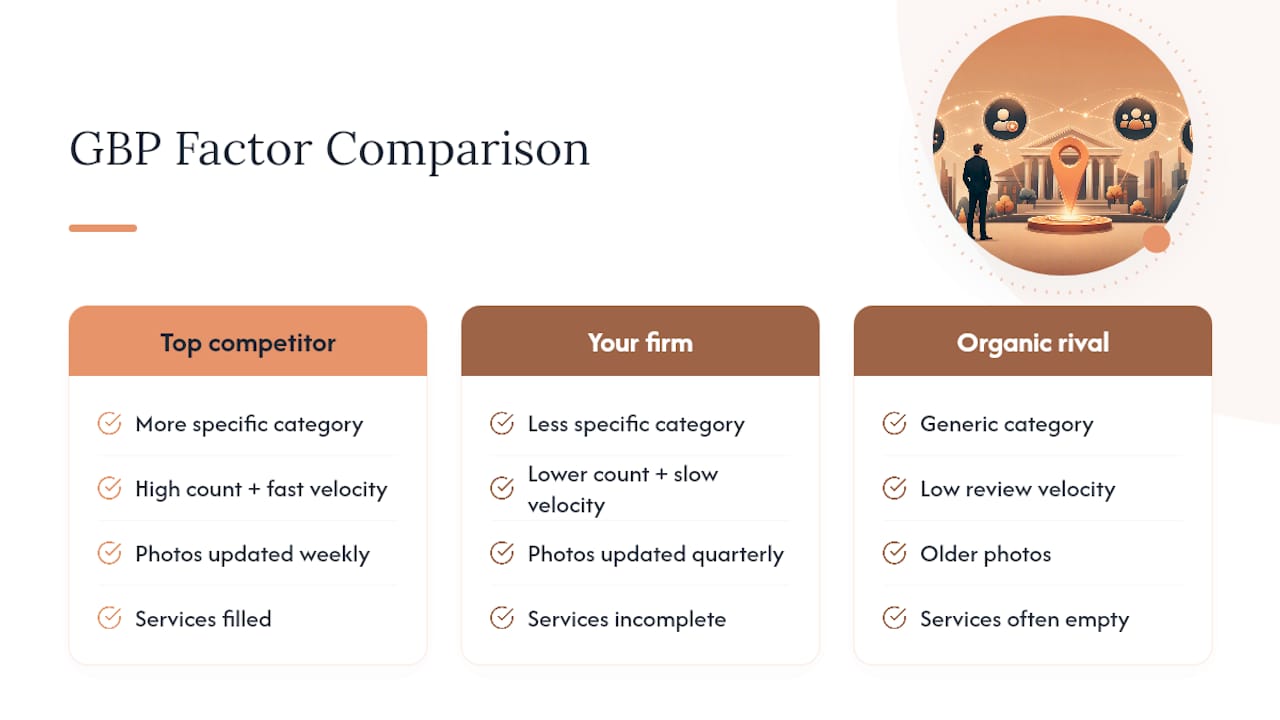
Search your target practice-area-plus-city query from an incognito browser and note who appears in the local pack. Open each competitor's GBP profile and check their category selection, review count and velocity, photo freshness, and whether they've filled out the services section. Firms frequently find a competitor outranking them purely because that competitor claimed a more specific category or posts GBP updates weekly while they post quarterly.
Check competitor location pages for word count, jurisdictional detail, and whether they mention specific local courts by name. Run their site through a backlink checker to see whether their local links come from genuinely local sources or generic legal directories anyone can join.
The gap analysis that matters most: if a competitor with fewer overall backlinks outranks you in the map pack, the answer is almost always GBP completeness or review velocity, not domain authority. Local pack ranking rewards different signals than organic ranking, and firms that only study organic competitors miss where the real gap sits.
Three Moves to Make This Month
If you're starting from zero, do three things in this order: fully rebuild your Google Business Profile categories and services, set up an attorney-personalized review request workflow, and rewrite one location page with real jurisdictional detail instead of templated copy. Everything else in this guide compounds on top of those three.
Ranking reports feel good to screenshot, but signed consultations pay the bills. I'd rather see a firm at position four in the map pack with a strong call-to-consult rate than a firm at position one that can't convert its calls. If you want a second opinion on where your firm's local presence actually stands, request an audit and see what the data says before you invest another dollar in tactics that won't move intake.
— Anas
Getting Started With Chrome Cactus Studio
Chrome Cactus Studio is the alternative to a traditional agency for local SEO for lawyers: instead of your account getting handed to a junior strategist managing forty other clients, a senior operator builds and runs your entire local presence personally, from GBP structure to schema to location-page content.

The engagement runs in three phases: an audit that maps your current GBP, citations, and location pages against the gaps this guide covers, an implementation phase where senior staff rebuild the weak points directly, and an ongoing measurement phase tracking signed consultations rather than rank screenshots. Firms have seen rapid statewide map-pack rises shortly after launch using this exact approach, described in more detail on the Chrome Cactus Studio methodology page. For firms specifically in the Phoenix metro, the Phoenix SEO service page outlines regional specifics.
Because the roster stays limited to seven clients, every engagement gets full senior attention rather than a fraction of one. If your firm is ready to move from a rank report to a consultation pipeline, start with an audit and see exactly where your local presence stands today.
Sources
- American Bar Association — 2023 Websites and Marketing Tech Report
- Schema
- Juris Digital — Local SEO 2026 for law firms