
Multi-location SEO is the practice of getting every physical storefront a business operates to rank in both local map results and organic search, in that specific city, without the locations cannibalizing each other. The single highest-leverage move you can make right now is building an authoritative, unique landing page for every location and pairing it with a fully verified, accurately categorized Google Business Profile. Everything else in this guide, governance, citations, reviews, AI visibility, builds on that foundation.
TL;DR:
- Building unique, hyperlocal location pages with specific details like staff, landmarks, and local proof significantly boosts rankings over templated content.
- Accurate Google Business Profiles with verified addresses, correct categories, and weekly fresh photos are crucial for visibility and should be managed in bulk for multiple locations.
- Consistent NAP data, review velocity, and location-specific citations are vital to prevent ranking drops caused by data drift or duplicate listings.
- URL structures should use subfolders for local pages to maximize domain authority, with separate domains only for distinct brands or language-specific sites.
- Senior-led management of location pages, GBP audits, and citation updates ensures quality and consistency, avoiding common pitfalls that cause multi-location SEO programs to fail.
Table of Contents
- What Is the Fastest Way to Rank in Multiple Cities?
- How Do You Build Location Pages That Don't Read as Duplicate Content?
- Google Business Profile at Scale: Verification, Optimization, and Bulk Management
- Reviews and Reputation: Building Review Velocity Per Location
- Citation Management: Keeping NAP Consistent Everywhere
- Subfolders, Subdomains, or Separate Domains: What Should Your URL Structure Be?
- Local Link Building: Earning Backlinks for Individual Storefronts
- Governance and Asset Workflows That Don't Collapse at 50 Locations
- Tracking and Attribution by Location: What to Measure and How
- How Do You Get Recommended by AI Search Tools Like ChatGPT?
- Why Boutique, Senior-Led SEO Beats Volume Agencies for Multi-Location Brands
- Get Multi-Location SEO Built by Senior Operators, Not Delegated to Juniors
- Resources Worth Bookmarking for Ongoing Multi-Location Work
- Sources
What Is the Fastest Way to Rank in Multiple Cities?
Ranking in multiple cities at once comes down to sequencing, not volume. Businesses that throw up 40 thin location pages overnight usually rank worse than businesses with 10 genuinely differentiated ones. Google, and increasingly AI answer engines, reward pages that read like they were written by someone who has actually been inside that building.
Here's the priority order that actually moves rankings, based on what tends to break first when chains scale past five or six locations:
- Location landing pages — unique content per address, not templated fluff. High impact, high effort.
- Google Business Profile accuracy — correct category, verified address, working phone. High impact, medium effort.
- NAP consistency — name, address, phone identical everywhere they appear online. High impact, low effort once centralized.
- Review acquisition and response — velocity and freshness per location. Medium-high impact, ongoing effort.
- Citation building and aggregator syndication — feeding the data graph that GBP and AI models pull from. Medium impact, low effort with the right tool.
- Site architecture decisions — subfolder structure that avoids duplicate or competing pages. High impact, one-time effort.
- Tracking and attribution — UTMs and call tracking tied to location IDs. Medium impact, foundational for proving ROI.
- Governance and asset workflows — who owns edits, who approves photos. Low visible impact, but it's what prevents collapse at scale.
- Local link building and community partnerships — slower burn, compounding impact.
The traps that sink most multi-location programs are predictable: duplicate or near-duplicate location pages that trigger internal competition and indexation issues, and NAP data that drifts out of sync the moment a location changes its phone number or moves two blocks over. Fix the sequencing above before you touch anything fancier.
How Do You Build Location Pages That Don't Read as Duplicate Content?
A location page earns its keep only if it contains information nobody could have written without visiting the actual site. That means real staff names, a genuine local landmark reference, actual parking instructions, not a city name swapped into a template while everything else stays identical.
Every location page needs these fields, non-negotiably:
- Full NAP block matching your master data sheet exactly
- Hours, including holiday exceptions specific to that address
- Embedded map and turn-by-turn directions from major nearby roads
- Services offered at that specific location (not the full corporate menu if a location doesn't carry it)
- Staff bios or photos for that location, when applicable
- Location-specific review snippets or a review widget
- At least one piece of local proof: a sponsorship, a community photo, a client from that city
The smart way to scale this without burning out your content team is a modular template: fixed structural blocks (schema, NAP, hours) paired with variable content blocks that force a writer to fill in real local detail rather than autopopulate boilerplate. A Wiideman study cited by BrightLocal found hyperlocal content on dedicated location pages delivered a 107% lift in rankings compared with generic, non-hyperlocal pages. That's not a marginal edge. That's the difference between showing up and not.
Pro Tip: Give every location page one paragraph no other page in your network shares, something like a specific event you sponsored, a landmark two doors down, or a staff member's name. That single paragraph is often what separates a page that ranks from one that gets filtered as duplicate.
On schema, every location page should carry LocalBusiness JSON-LD with name, address, telephone, openingHours, geo, and a sameAs array pointing to that location's specific social profiles and its GBP listing. Skip the sameAs array and you're leaving entity-linking signal on the table.
As for when a full location page beats a lighter regional or service-area page: if you have a staffed, visitable address, build the full page. If you're covering a service radius with no storefront, a service-area page with honest language about coverage (not a fake address) is the correct call, and it protects you from Google's spam filters for fake local presence.
Google Business Profile at Scale: Verification, Optimization, and Bulk Management
Every physical storefront needs its own individual GBP listing, verified separately. Businesses with 10 or more locations qualify for bulk verification through Google's official process, which saves weeks compared to verifying one at a time by postcard.
Fields worth obsessing over once verified:
- Primary category (the single most influential ranking factor in the profile itself)
- Secondary categories that reflect real services, not aspirational ones
- Photos uploaded weekly, not just at launch
- Attributes (accessibility, payment types, appointment-only status)
- Services list matched to what that specific location actually provides
- Q&A section seeded with the questions your staff actually get asked
Bulk management tools cut down on the two failures that plague chains: mismatched website URLs (a location page pointing to the wrong city's page) and wrong categories chosen by whoever set up the listing years ago and never revisited. Both are silent rank killers because they don't throw errors, they just underperform.
Pro Tip: Every GBP website link should carry a UTM string with a location ID baked in, something like utm_source=gbp&utm_medium=organic&utm_campaign=location_scottsdale. Without it, you cannot tell which storefront's listing is actually driving calls versus which one is dead weight.
Reviews and Reputation: Building Review Velocity Per Location
Review freshness is a trust signal both Google and AI models weigh heavily, and a location that hasn't earned a review in four months reads as dormant even if it's thriving. New locations should target roughly two new reviews a month at minimum during the first year; established locations need steady flow, not just volume.
Tactics that actually produce reviews instead of just asking for them:
- Location-specific short review links (not one generic corporate link diluted across every store)
- In-store prompts at the point of a completed transaction, not a delayed email three days later
- One follow-up text or email, timed to when satisfaction is highest
- A response SLA: every review, positive or negative, answered within 48 hours
- A templated but personalized response framework so franchise owners aren't improvising
Route reviews into whatever CRM your locations already use, with an alert triggered on anything under four stars so a regional manager sees it same day, not next week during a monthly report.
Citation Management: Keeping NAP Consistent Everywhere
Inconsistent NAP data across the web is the quiet reason a lot of otherwise well-optimized multi-location businesses stall out in the map pack. A master data sheet, one canonical source of truth, should lock down business name formatting, address style, phone number format, hours, an internal location ID, and the corresponding GBP URL for every single site.
Syndicate that master sheet to the aggregators that actually feed downstream directories and, increasingly, AI models: Data Axle, Foursquare, Localeze, HERE, and Apple Maps sit at the top of that food chain, with hundreds of smaller directories pulling from them.
- Audit citations quarterly, not annually; drift happens faster than most teams expect
- Suppress duplicate listings the moment they're found, they split review counts and confuse the data graph
- Use paid syndication tools for scale, but manually spot-check the top 20 highest-traffic locations
- Keep
sameAsschema and social profile links current, since they help search engines and AI systems tie one entity to its many mentions across the web
Subfolders, Subdomains, or Separate Domains: What Should Your URL Structure Be?
Subfolders win by default for the overwhelming majority of multi-location businesses. A structure like yourdomain.com/locations/scottsdale centralizes domain authority instead of splitting it across separate properties that each start from zero trust.
Search Engine Land's guidance on structuring geographic pages at scale makes the case plainly: organize pages around your real-world business structure and build the smallest number of pages necessary to represent the brand clearly. More URLs isn't more authority. It's often internal competition.
When a separate domain or subdomain actually makes sense:
- Genuinely distinct brands operating under one parent company
- Different languages requiring separate hreflang-managed properties
- Legal or franchise-agreement separation requiring independent web presences
URL and linking conventions worth locking in from day one:
- One canonical URL per location, no parameter variants indexed
- A clear hierarchy: homepage → region hub → city location page → service pages
- Cross-linking between nearby locations and their shared regional hub
- A dynamically updating XML sitemap segment specifically for location pages, resubmitted whenever a location opens or closes
Pro Tip: When a location closes, don't delete the page and let it 404. Redirect it to the nearest active location's page with a 301, and update your sitemap the same day. A dead location page bleeding link equity is a common, avoidable loss.
Local Link Building: Earning Backlinks for Individual Storefronts
The links that move a single location's rankings rarely come from national outreach campaigns. They come from local newspapers covering a store opening, chamber of commerce directories, event sponsorship pages, and youth sports team pages listing their sponsors.
A workable operational model:
- Build one templated outreach pitch, then let regional managers localize it with real specifics
- Sponsor one recurring local event per location annually rather than scattering small one-off donations
- Track every placement in a shared sheet with the referring domain, the location it supports, and the date
Prioritize outreach effort toward locations with the weakest current backlink profiles rather than spreading attention evenly. Measure success through referral traffic in analytics and manual searches for brand mentions tied to each city, since not every mention includes a link worth tracking through Search Console alone.
Governance and Asset Workflows That Don't Collapse at 50 Locations
Every multi-location program that falls apart does so for the same reason: nobody owns the edit. A clear role structure prevents that.
- Central SEO team sets standards, schema templates, and approves major structural changes.
- Regional managers own citation accuracy and review response oversight for their territory.
- Local location owners submit photo and content updates through a standardized request form, never by editing pages directly.
Image assets are the most common bottleneck at this scale. Waiting on a central designer to approve every location's photo submission creates a backlog that stalls launches for months. The fix is a standardized checklist, minimum resolution, no watermarks, storefront and interior shots required, plus an automated intake form that routes submissions without a human gatekeeper unless something fails the checklist.
Pro Tip: Set a quarterly change-management cadence: one day each quarter where every location's NAP, hours, and photos get reviewed against the master sheet. Skipping this is how businesses discover eight months later that eleven locations have the wrong holiday hours listed.

Decide upfront what gets automated (bulk hours updates, holiday schedules) versus what always requires a human sign-off (category changes, new service listings, anything touching legal business name).
Tracking and Attribution by Location: What to Measure and How
You cannot manage what you cannot attribute to a specific address. Every GBP link, every local ad, and every citation listing needs a UTM string carrying a location ID, something structured like utm_source=gbp&utm_medium=local&utm_campaign=loc_tempe, kept consistent across your entire naming convention document so nobody invents a new format six months in.
The setup that actually produces usable data:
- A unique tracking phone number per location, routed through call tracking software and synced to your CRM
- A dashboard, Looker Studio is a common choice, pulling GBP insights, GA4 location-page traffic, and call volume into one view per location
- Weekly automated reports flagging any location with a sudden drop in calls or profile views
Backlinko's operational research on multi-location SEO treats per-location tracking as a core requirement, not a nice-to-have, precisely because attribution failures are what make executives pull budget from working campaigns. The most common validation error: forgetting to exclude internal traffic from location-page analytics, which quietly inflates numbers and masks real performance gaps.
How Do You Get Recommended by AI Search Tools Like ChatGPT?
AI assistants recommend businesses based on a trust triangle: consistent business data, a brand-owned location page that reads as authoritative, and third-party corroboration across reviews and directories. Search Engine Journal's research on winning AI search visibility frames this as the deciding factor for whether a business gets cited when someone asks an AI model for a recommendation in their city.
Concrete moves that improve your odds of being the answer instead of the competitor's:
- Write location pages with clear factual statements an AI model can lift directly: exact hours, exact services, exact neighborhood
- Add an FAQ block per location answering the specific questions locals actually ask, phrased the way people actually ask them
- Keep schema and
sameAslinks tight so entity resolution engines connect your GBP, website, and social profiles as one coherent entity rather than several unrelated ones - Maintain review quality and volume, since AI systems weight review sentiment heavily when deciding what to surface
One practical habit: run your own prompts periodically, "best [service] in [city]", against ChatGPT, Google's AI overviews, and Perplexity, then log whether your locations get mentioned. That log becomes your coverage baseline and shows you exactly which cities need reinforcement first.
Why Boutique, Senior-Led SEO Beats Volume Agencies for Multi-Location Brands
Most multi-location SEO advice gets written by people who've never had to actually keep 30 GBP listings synced with a master data sheet while a franchise owner in one city renames their storefront without telling anyone. The gap between the checklist and the execution is where most programs actually die.
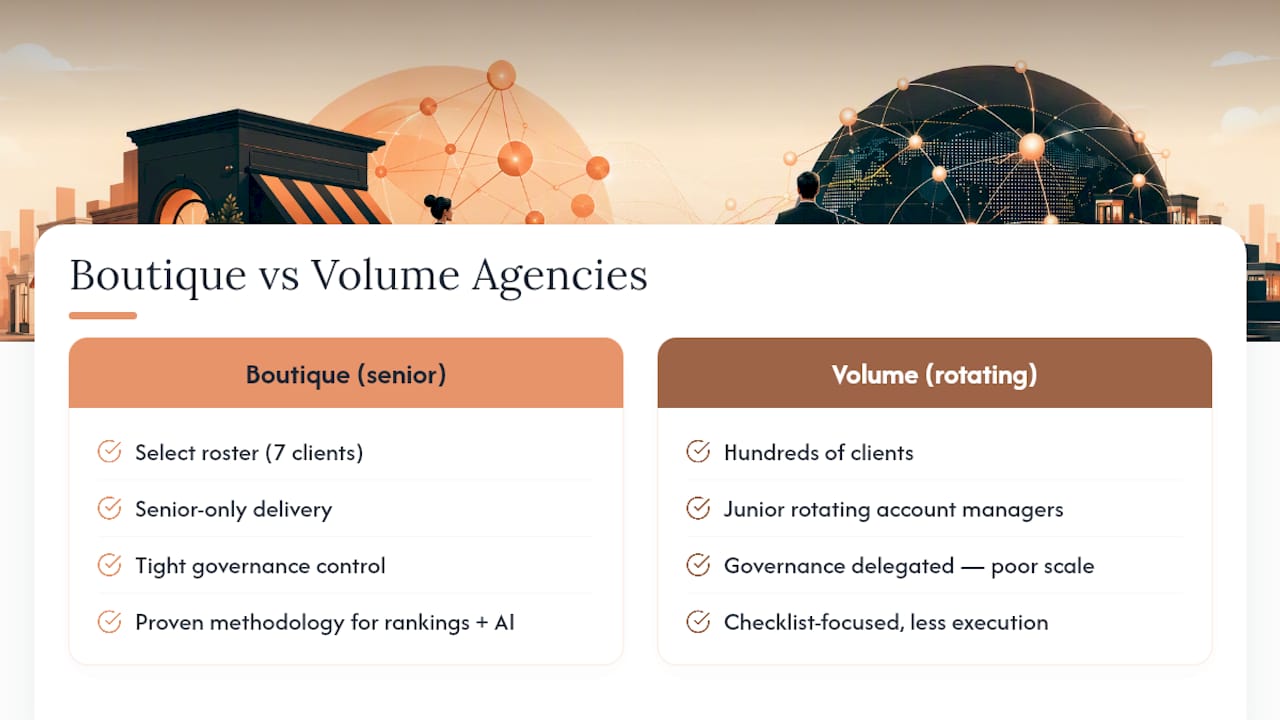
Chrome Cactus Studio works with a select roster of seven clients specifically because multi-location governance doesn't scale well when it's delegated to a rotating cast of junior account managers. Every location page, every GBP audit, every citation cleanup runs through senior hands using a proven methodology built for both traditional Google rankings and the AI-driven search tools now shaping how customers find a business. Clients have seen locations reach number one statewide shortly after launch, not because of volume, but because the trust triangle, business data, location page authority, and third-party corroboration, gets built correctly the first time.
The uncomfortable truth about this industry: agencies that manage hundreds of clients cannot give any single multi-location account the governance attention this playbook demands. Quality engagements and senior-only delivery aren't a marketing angle. They're the only structure that actually keeps 10, 30, or 100 locations from drifting into inconsistency six months after launch.
— Anas
Get Multi-Location SEO Built by Senior Operators, Not Delegated to Juniors
If you've read this far, you already know the hard part isn't understanding multi-location SEO, it's executing it consistently across every location while your team is busy running the actual business. That's the exact gap Chrome Cactus Studio was built to close.

Instead of a high-volume agency handing your account to whichever junior has bandwidth this month, Chrome Cactus keeps engagements limited to a small roster so senior operators handle your location pages, GBP audits, citation cleanup, and AI visibility work directly, no handoffs, no account churn. For businesses expanding across metro markets, the Phoenix SEO service applies this exact playbook to regional expansion, from architecture decisions down to per-location tracking setup.
If your locations are competing with each other in search instead of compounding, or your GBP profiles have drifted out of sync since launch, get in touch through Chrome Cactus Studio and find out what a senior-led audit of your current footprint actually looks like.
Resources Worth Bookmarking for Ongoing Multi-Location Work
For deeper reading beyond this playbook, Google's own Business Profile help center remains the authoritative source on verification requirements and bulk listing management. BrightLocal's multi-location guide and Backlinko's operational breakdown both offer useful tactical detail on citation building and tracking setup.
For tooling, citation management platforms handle aggregator syndication and duplicate suppression at scale, call-tracking software ties phone leads back to individual locations, and Looker Studio remains a common choice for building the kind of per-location dashboard this guide recommends. None of these replace a governance structure, but they make one far easier to run.
Sources
- Search Engine Journal — Multi-Location SEO: How To Win Google & AI Search Visibility At Scale
- Search Engine Land — Multi-location SEO: How to structure geographic pages at scale
- Backlinko — Multi-location SEO